一
人教PEP版
1、三年級上冊期中知識總結
(1)Unit 1 Hello!
重點單詞
pen(鋼筆)
pencil(鉛筆)
pencil-box( 鉛筆盒)
ruler(尺子)
eraser(橡皮)
crayon(蠟筆)
book(書)
bag(書包)
no(不)
your(你的)
重點句型
1.向別人問好應該說――
A: Hello!你好!
展開全文
B: Hi!你好!
2.問別人的名字應該說——
A:What's your name小學?你的名字是什麼?
B:My name's Chen Jie.我的名字是陳潔小學。
3.跟別人分手應該說――
A: Bye.\ Good bye!再見
B: See you. 再見\ Goodbye.再見
4.A: I have a pencil\ bag\ruler. (我有一隻鉛筆\書包\尺子小學。)
B: Me too.我也有小學。
必背句型
1.Show me your pencil/ ruler/ eraser/ crayon/pen. 讓我看看你的鉛筆/尺子/橡皮/蠟筆/鋼筆小學。
2.Open your pencil-box. 開啟你的鉛筆盒小學。
3.Close your book .合上你的書小學。
4.Carry your bag. 背起你的書包小學。
(2)Unit 2 Colours
重點單詞
red (紅色的) yellow (黃色的) green (綠色的)
blue (藍色的) purple (紫色的) white (白色的)
black (黑色的) orange (橙色的) pink (粉色的)
brown (棕色的) OK(好小學,行) Mum(媽媽)
重點句型
1.早上相見應該說—
A: Good morning. 早上好小學!
B: Good morning! 早上好!
2.下午相見應該說――
A: Good afternoon! 下午好小學!
B: Good afternoon! 下午好小學!
3.跟新朋友第一次見面——
A: Nice to meet you! 見到你很高興小學。
B: Nice to meet you小學,too! 見到你也很高興!
4.A: This is Mr. Jones. 這是瓊斯先生小學。
B: Nice to meet you! 見到你很高興小學。
5.A: Colour it brown. 把它塗成棕色吧小學!
B: Ok. 好小學。
6.I see green. 我看見綠色小學。
必背句型
1.Show me green. 給我看看綠色
2.Show me red. 給我看看紅色
3.Show me blue. 給我看看藍色
4.Show me yellow. 給我看看黃色
5.Black, black. Stand up. 黑色小學,黑色,站起來(起立)!
6.Orange, orange. Sit down. 橙色小學,橙色,坐下!
7.White, white. Touch the ground. 白色,白色,摸摸地板小學。
8.Brown, brown. Turn around.棕色,棕色,轉個圈小學。
(3)Unit 3 Look at me
重點單詞
head(頭) face(臉) nose(鼻子) mouth(嘴)
eye(眼睛) ear (耳朵) arm(胳膊) finger(手指)
leg(腿) foot(腳) body(身體)
重點句型
1. A: Let's go to school! 讓我們一起去上學小學!
B: OK! 好的小學。
2. 看見久未見面的朋友或者別人身體不舒服小學,你該這麼打招呼——
A: How are you ? 你好嗎小學?
B: Fine,thank you我很好,謝謝你小學。也可回答:Very well, thanks!
3. A: Let's play. 讓我們玩吧小學。
B: OK. 好的小學。
4. A: Let's make a puppet. 讓我們做一個木偶小學。
B: Great! 棒極了
必背句型
1. Close your eyes. 閉上你的眼睛小學。
2. Open your mouth. 張開你的嘴巴小學。
3. Touch your nose. 摸摸你的鼻子小學。
4. Touch your ear. 摸摸你的耳朵小學。
5. Touch your face. 摸摸你的臉小學。
6. Look at me. 看我小學。
7. This is my face. 這是我的臉小學。
8. Clap your hands. 拍拍你的手小學。
9. Touch your head. 摸摸你的頭小學。
10. Wave your arms. 揮揮動你的胳膊小學。
11. Shake your legs. 抖抖你的雙腿小學。
12. Shake your body. 扭扭你的身體小學。
13. Stamp your foot. 跺跺你的腳小學。
2、四年級上冊期中知識總結
(1)Unit 1 My classroom
重點單詞
classroom 教室
window 窗戶
black board 黑板
light 電燈
picture圖畫
door 門
floor 地板
computer 計算機
teacher’s desk 講臺
wall 牆
fan 扇子
near距離近
really 真的
TV 電視
clean 打掃
help 幫助
拼讀的單詞
cake蛋糕 face 臉
name 名字 make製作
重點句型
We have a new classroom,. 我們有一個新教室小學。
Let's go and see 讓我們一起去看看吧小學。
What's in the classroom? 教室裡面有什麼小學?
One blackboard, one TV, many desks and chairs.
Where is it ? 它在哪兒小學?
It’s near the window. 它在窗戶旁邊小學。
It’s so big. 它很大小學。
Let's clean the classroom. 讓我們一起打掃教室
Let me clean the windows. . 讓我來擦窗戶小學。
The door is orange.門是橙色的小學。
重點語法
where 引導的是特殊疑問句小學,“哪裡”,看到where 就要想到地點,方位詞 ,例如on, in ,under, near等
語法點小學:let’s = let us 讓我們 let me 讓我
文化知識:想問別人問題,要先說“excuse me對不起,打擾一下小學。”
(2)Unit 2 My schoolbag
重點單詞
schoolbag 書包 Chinese book 語文書
English book 英語書 math book 數學書
story-book 故事書 candy糖果
notebook筆記本 toy玩具
key鑰匙 lost丟失
so much非常的 cute可愛的
拼讀的單詞
like喜歡 kite 風箏 five 五
nine 九 rice米飯
重點句型
What's in your schoolbag?你書包裡有什麼小學?
An English book, a maths book, three storybooks and…
一本英語書小學,一本數學書,三本故事書和……
I have a new schoolbag. 我有一個新書包小學。
What colour is it? 它是什麼顏色的小學。
It’s black and white. 它是黑色和白色的小學。
重點語法
語法點:what colour引導的也是特殊疑問句, 問的是顏色,回答中肯定有例如purple,red 等等小學。
(3)Unit 3 My friends
重點單詞
strong 強壯的 friendly 友好的
hair 頭髮 quiet 安靜的
shoe鞋 glasses眼鏡
his 他的 or或者
right正確的小學,對的
hat 帽子 her 她的
拼讀的單詞
nose鼻子 note 注意小學,便條
Coke可樂 Mr Jones瓊斯先生
重點句型
I have a new friend. 我有一個新朋友小學。
A Chinese friend? 一箇中國朋友小學?
What’s his name ? 他的名字叫什麼小學?
His name is Zhang Peng. 他的名字叫張朋小學。
He’s tall and strong.他很高也很強壯小學。
Who is he ?他是誰小學?
His name is Wu Yi fan.他叫吳一帆小學。
He has short hair. 他有短頭髮小學。
My friend has glasses and his shoes are blue.
我的朋友戴著眼鏡穿著藍色的鞋子小學。
You’re right! 你說對了小學。
What’s her name? 她的名字叫什麼小學?
Her name is Amy. 她的名字叫Amy.
3、五年級上冊期中知識總結
(1)Unit 1 What's he like?
重點單詞
old 老的小學,年紀大的
young年輕的小學,歲數不大的
funny 滑稽的小學,可笑的
kind 體貼的小學,慈祥的,寬容的
strict 要求嚴格的小學,嚴厲的
polite 有禮貌的小學,客氣的
shy 羞怯的小學,靦腆的,怕生的
helpful 有用的小學,願意幫忙的
clever 聰明的小學,聰穎的
hard-working 工作努力的小學,辛勤的
music 音樂
art 美術
science科學
English 英語
maths/math 數學
Chinese 語文小學,中文
sometimes 有時小學,間或
robot 機器人
speak 會說小學,會講(某種語言);用(某種語言)說話
重點句型
1. —Who's your art teacher? 誰是你的美術老師小學?
—Mr. Jones.瓊斯老師小學。
2. —Is he young? 他年輕嗎小學?
—Yes, he is. 是的,他年輕小學。 —No, he isn't. 不,他不年輕。
3. —What's Wu Yifan like? 吳一帆怎樣小學?
—He's hard-working. 他很勤奮小學。
4. Ms Wang will be our new Chinese teacher. 王老師會成為我們的新語文老師小學。
5. He is very helpful at home. 他在家很能幹小學。
6. Robin is short but strong. 羅賓個子矮,但是身體強壯小學。
7. He can speak Chinese and English. 他會說中文和英語小學。
8. He makes me finish my homework. 他讓我寫作業小學。
語音
字母y在單詞中的發音:1、雙音節或多音節詞末發[ i ]小學。
例小學:baby嬰兒 happy開心的 windy有風的
sunny晴朗的 sorry對不起 candy糖果
many許多 family家庭 party聚會
課外補充
y在單音節詞末發[ ai ]
例小學:by 乘坐 my 我的 why 為什麼 cry 哭 fly 飛
重點知識及語法
1、詢問他人的外貌或性格小學:-What's he/she like? - He/She is kind/…
2、一般疑問句的問與答:—Is he/she…小學?—Yes, he/she is. —No, he/she isn't.
—Do you know…? —Yes, I do. —No, I don't
3、be動詞的三種形式am, is, are與人稱代詞連用的用法小學:
I + am,
He, she, it小學,人名、物名+ is
We, you, they + are
4、Ms., Miss, Mr., Mrs.的區別:
Ms. [miz](縮略詞)(用於女子的姓氏或姓名前小學,不指明婚否)女士;
Miss [mis](用於未婚女子的姓氏或姓名前小學,以示禮貌)小姐,女士;
Mr. [mistE](mister的縮略詞)(用於男子的姓氏或姓名前)先生小學;
Mrs. [misiz](用於已婚女子的姓氏或姓名前)太太;夫人小學。
5、and和but的區別小學:
and “和,與”,表並列關係 He is tall and thin. 他又高又瘦小學。
but “但是”,錶轉折關係 He is short but strong. 他個子矮,但是身體強壯小學。
重點作文
1、介紹自己、朋友或老師等熟悉的人物,如:My …teacher/friend/…小學。
思路導引
(1)開頭小學:交代人物的身份 I have a/an…He/She is…
(2)中間小學:
1)體貌 He/ She is tall/strong… He/She has …hair/eyes…
2)性格 He/She is strict/kind…
3)愛好 He/She likes playing pingi-pong/… 或He/She often read books/… on the weekend.
(3)結尾小學:評價人物或抒發對人物的情感 I like him/her very much.
2、範文小學:(1)課本P9 Read and write
(2)My Chinese teacher
I have a new Chinese teacher. She is Ms. Chen. She is tall and thin. She has big eyes and long black hair. She is kind and funny. Sometimes she is strict, too. She is hard-working. She likes reading. Her class is so much fun. We all like her.
(2)Unit 2 My week
重點單詞
Sunday (Sun.) 週日 Monday (Mon.)
週一 Tuesday (Tue./Tues.) 週二
Wednesday (Wed./Weds.) 週三
Thursday (Thur./Thurs.) 週四
Friday (Fri.) 週五
Saturday (Sat.) 週六
weekend 週末(週六、日)
wash my clothes 洗衣服 watch TV 看電視
do homework 做作業read books 看書
play football 踢足球 on the weekend 在週末
play sports/do sports 做體育運動 listen to music 聽音樂
play ping-pong 打乒乓球
重點句型
1. —What do you have on Thursdays? 星期四你們上什麼課小學?
—I have math, English and music. 我們上數學、英語和音樂課小學。
2. —What do you do on Thursdays, Grandpa? 爺爺小學,星期四你要做什麼?
—I have a cooking class with your grandma. 我和你奶奶去上烹飪課小學。
3. —Do you often read books in this park? 你經常在這個公園看書嗎小學?
—Yes, I do. 是的 —No, I don't. 不是
4. Look at my picture. 看我的圖片小學。
5. You look tired. 你看起來很累小學。
6. You should play sports every day. 你應該每天做運動小學。
語音
字母組合ee, ea在單詞中的的發音小學:[ i: ]
feet腳 beef牛肉 meet遇見 see看見
feed餵養 tea茶 read閱讀 eat吃
repeat 重複
注:1、ee組合絕大部分發長音[ i: ]小學,只有少部分發短音[ i ],如:coffee 咖啡
2、ea字母組合除了發[ i: ]小學,還有可能發[ e ]等發音,如:bread 麵包,或者發[ ei ],如:great 好極了
重點知識及語法
1、詢問做什麼事/活動小學:—What do you do …? —I often play ping-pong…
詢問星期幾上什麼課小學:—What do you have on…? —We have English class…
2、一般疑問句的問與答小學:—Do you often read books? —Yes, I do.
—No, I don't.
3、 on+具體某一天(年月日小學,星期),如:on Monday/Tuesday…
課外 at+具體時刻(…點鐘)小學,如:at 12 o'clock 在十二點整
補充:in+大致時間(年月小學,早中晚),如:in 2014 在2014年
in the morning/afternoon/evening 在上午/下午/晚上
4、play + 球類、棋類、娛樂活動小學,如:play football/ping-pong
補充:play + the + 樂器(第四單元知識)小學,如:play the pipa/piano/violin…
重點作文
1、描寫一週的生活小學,如:My week
思路導引
(1)開頭小學:簡單的自我介紹:My name's…/ I'm…
(2)中間:1)介紹週一至週五的情況小學,可以著重介紹自己最喜歡的那一天:
I go to school from Monday to Friday. I like…because I have…
2)介紹自己週六、日的活動小學:I often watch TV/…on the weekend.
(3)結尾小學:This is my week. What about yours?
2、範文小學:
My week
My name is Li Ming. I go to school from Monday to Friday. I like Tuesdays and Thursdays, because I have music and PE. I often do my homework and read books on Saturdays. I often play ping-pong on Sundays.
(3)Unit 3 What would you like?
重點單詞
ice cream 冰淇淋 hamburger漢堡包
tea茶 sandwich 三文治
salad 沙拉 fresh 新鮮的小學,剛摘的
healthy 健康的 delicious 美味的小學;可口的
hot 辣的小學;辛辣的 sweet 含糖的;甜的
hungry 餓的 thirsty 渴的小學;口渴的
favourite 特別喜愛的 food 食物
drink 喝小學;飲 carrot 胡蘿蔔
onion 洋蔥 chicken 雞肉
milk 牛奶 bread 麵包
beef noodles 牛肉麵
fish sandwich 魚肉三明治
tomato soup 西紅柿湯
重點句型
1.—What would you like to eat? 你想吃什麼小學?
—A sandwich, please. 請給我一個三明治小學。
—What would you like to drink? 你想喝什麼小學?
—I'd like some water. 我想喝點水小學。
2.—What's your favourite food? 你最喜歡吃什麼食物小學?
—Noodles. They are delicious. 麵條小學。麵條很好吃。
3. My/His /Her favourite food is fish. 我/他/她最喜歡的食物是魚小學。
4. I'm hungry/thirsty. 我餓/渴了小學。
5. I don't like beef but chicken is OK. 我不喜歡牛肉但是雞肉也可以小學。
6. Onions are my favourite vegetable. 洋蔥是我最喜歡的蔬菜小學。
7. I like vegetables but not carrots. 我喜歡吃蔬菜但不喜歡胡蘿蔔小學。
語音
字母組合ow在單詞中的發音:[ au ] 小學,[ Eu ]
例小學:[ au ] cow 奶牛 flower 花 wow 哇 down 向下
how 如何小學,怎樣 now 現在
slow 慢的 snow 雪
yellow 黃色 window 窗戶
snowy 下雪的 tomorrow 明天
重點知識及語法
1、詢問想要吃/喝什麼小學:—What would you like to eat/drink? —I'd like…
2、詢問最喜歡的事物小學:—What's your favourite food/vegetable/…? —My favourite food/…is…/I like…
3、名詞複數的規則變化小學:
(1)直接加s小學;
(2)以s, x, sh, ch結尾的小學,加es,如, buses boxes sandwiches
(3)以o結尾小學,有生命的加es,如,potatoes tomatoes
無生命的加s小學,如,photos pianos zoos
補充小學:
(4)以子音加y結尾小學,改y為i再加es,如,families babies
以母音加y結尾小學,直接加s,如,boys days
(5)以f或fe結尾小學,改f為v再加es,如knife-knives 小刀 leaf-leaves 樹葉
4、some+可數/不可數名詞 例小學:some apples(可數)
some water/rice/juice/bread/…(不可數)
課外補充
不可數名詞(詞後不可以加-s/es小學,所接動詞用單數is /V-s/es)
液體 water milk tea orange(桔汁) coke juice
氣體 air(空氣)
食物 food rice bread fruit
肉類 meat(肉) fish beef chicken
物質work(工作) paper(紙) time music weather(天氣) snow money
重點作文
1、描述自己和家人最喜愛的食物
思路導引
(1)開頭小學:簡單介紹自己的家庭成員:There are…people in my family. They are…
(2)中間小學:分別介紹每個家庭成員最喜愛的食物是什麼:…favourite food is…/…is…favourite./…like(s)…best.
(3)結尾小學:穿插說明喜歡的原因:It's/They're…
2、範文小學:(1)課本P29 Read and write
(2) There are four people in my family. They are my parents, my brother and me. My mother likes salad best. It's fresh. Beef is my father's favourite. He thinks(認為)it's delicious. My brother likes ice cream. It's sweet. My favourite food is fish. It's very healthy.
4、六年級上冊期中知識總結
(1)Unit 1 How can I get there?
重點單詞、短語
where哪裡
how 怎樣
can能夠
near近的
ask問
tell 告訴
far遠的
science科學
hospital 醫院
museum 博物館
post office 郵局
library圖書館
bookstore 書店
usually通常
sometimes有時候
often 經常
know知道
near旁邊
next to旁邊(比near更近)
crossing 十字路口
turn left 向左轉
turn right 向右轉
go straight直走
in front of在…的前面
behind在...的後面
重點句型
1.How do you go to school? 你是怎樣去上學的小學?
2.where is the restaurant? 餐館在哪裡小學?
3.Usually I go to school on foot.我通常走路去上學小學。
4.Sometimes I go by bike.有時候我騎腳踏車去小學。
5.問路之前,出於禮貌,我們要說“Excuse me.”與後面的句子要用標點符號隔開小學。
6.Look at the traffic lights, remember the traffic rules.看著交通燈,記住交通規則小學。
7.Stop at a red light.Wait at a yellow light.Go at a green light.紅燈停小學。黃燈等一等。綠燈行。
8.Red means stop, yellow means wait, green means go.紅色的意思是停止,黃色的意思是等待,綠色的意思是通行小學。
9.How can I get to the park? 我該怎樣到達公園呢小學?
10.You can go by the No.15 bus.你可以坐15路公交車去小學。
重點知識及語法
1.坐某種交通工具用by,例如:by bike, by train小學。而走路用 “on” 例如on foot.
2.國家名字小學,地方名字第一個字母要大些:例如:Canada加拿大, China中國, America美國, England英國, Australia澳大利亞
3.頻度副詞是表示做的次數多少的詞語小學。從多到少依次排列為:
always總是,usually通常,often經常,sometimes有時候,never從不小學。
頻度副詞可以放在句首,也可以放在人稱後面小學。
例如小學:Usually I go to school by bus.= I usually go to school by bus.
4.near近的,far遠的小學。這兩個詞是一對反義詞。
注意小學:not near= far, not far = near.
5.時間前面用at.例如小學:在三點鐘:at 3 o’ clock.
6.交通燈traffic lights,交通規則:traffic rules小學。這大部分的國家都是靠右行駛的:drivers drive on the right side of the road.
記住England and Australia,drivers drive on the left side ofthe road.英國和澳大利亞,司機是靠左行駛的小學。
7.on foot= walk, 都是走路的意思,但是用法不同,on foot用在句子末尾,而walk用法與go相同,可以代替go的位置小學。
例如小學:走路回家:walk home 走路去上學:walk to school
走路去上班 walk to work 走路去醫院walk to the hospital
(2)Unit2 Ways to go to school
重點單詞、短語
by bike騎腳踏車
by bus坐公車
by train坐火車
by plane坐飛機
By ship坐輪船
by subway坐地鐵
by taxi 乘計程車
on foot= walk 走路
Excuse me打擾一下
please請
buy買
want to想要
a pair of一雙
get on上車 get off下車 turn left左轉 turn right右轉
am上午 pm下午 now現在 look for尋找 top停止 wait等待 get to到達 driver司機 must必須
重點句子
1.Let’s go to the nature park,讓我們一起去公園吧小學!
2.How do we get there?我們怎樣到達這裡?By bus乘公交小學。
3.The park is over there,公園在那裡小學。
4.Let’s go .我們一起出發吧小學!
5.Slow down and stop at a yellow light.黃燈等一等小學。
6.Stop and wait at a red light.紅燈停小學。
7.Go at a green light.綠燈行小學。
重點知識
1.Is there 開頭的問句怎麼回答呢小學?
例如:Is there a cinema near here? 只要把前兩個詞語的順序換一下就可以了小學,肯定回答是:Yes, there is.否定:No, there isn’t.
2.buy 和 by的區別這兩個詞語發音相同小學,但是意思完全不同,by:乘,坐 buy:買
3.地點名詞前面一定要有the小學,
例如小學:Where is the cinema?How can I get to the hospital?
4.時間前面用at.例如:在三點鐘:at 3 o’ clock.;一段時間前面用for,例如:三分鐘for 3 minutes. 星期前面用on小學,例如:on Monday, on Tuesday, on Wednesday,on Thursday, on Friday, on Saturday, on Sunday.
5.在表達第幾路公交車時小學,注意No.的書寫,N要大寫,後面別少了一點!!!
6.在哪裡上下車,在哪裡左右轉,都用介詞at,例如:Get on/ off at the cinema.在電影院的地方上下車小學。Turn left/ right at the bookstore.在書店的地方左右轉。
7.by the No.12 bus= take the No.12 bus.坐12路公交車
(3)Unit3 My weekend plan
重點單詞
take a trip旅行
read a magazine讀一本雜誌
go to the cinema去看電影
this morning今天上午
this afternoon今天下午
this evening今天晚上
next week下個星期
tomorrow明天
tonight今晚
busy忙碌的
go home回家
post card明信片
comic book漫畫書
newspaper報紙
dictionary字典
plant trees種樹
重點句子
1.What are you going to do on the weekend?週末你將要做什麼小學?
2.I'm going to visit my grandparents this weekend.我將要去拜訪我的祖父母小學。
3.I'm going to have a busy weekend! 我將度過一個忙碌的週末小學。
4.I'm going to the supermarket with my mother.我將要和我媽媽去超市小學。
5.Where are you going this afternoon? 今天下午你將要去哪小學?
6.I'm going to the bookstore.我將去書店小學。
7.What are you going to buy? 你將要買什麼小學?
8.I'm going to buy a comic book.我將要去買一本漫畫書小學。
9.When are you going? 你將什麼時候去小學?
10. I'm going at 3 o’clock.我將三點鐘去小學。
11.What are you going to be? I'm going to be a policeman.
你將要成為什麼樣的人?我將要成為一名警察小學。
重點知識
1.時間往往放在句子的末尾小學。例如:What are you going to do this evening?
2.go to school去上學,go to work去上班, go to the cinema去看電影,go後面都要有to,但是要注意“回家”這個片語是:go home,中間絕對沒有to小學。
3.with: 和,後面往往跟人小學。例如:I'm going to play football with my friends.我將要和我的朋友一起去踢足球。
4.疑問詞小學:
where:哪裡(地點) what:什麼(東西小學,事情或職業)
when小學:什麼時候(時間) how:怎麼樣(交通工具)
who小學:誰(人) why:為什麼(答句中有because)
二
外研版
三年級英語上冊期中複習提綱
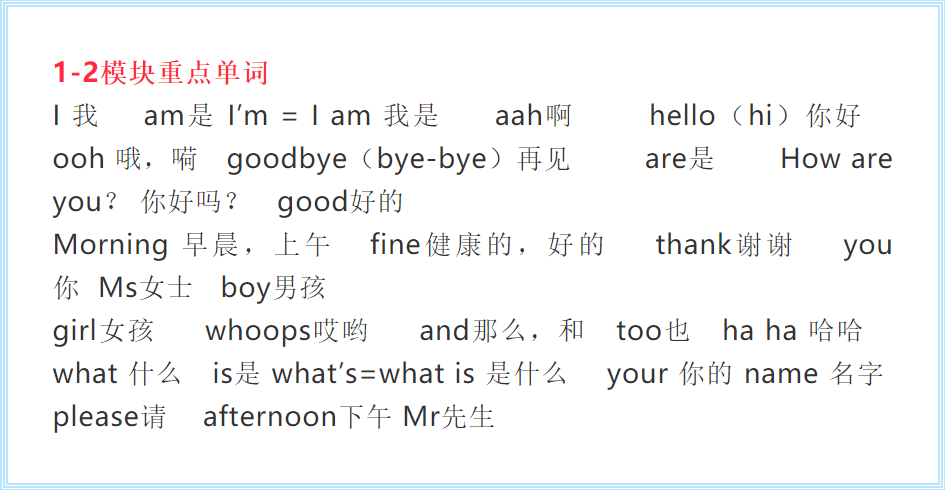
Module 1
Hello,I'm Sam. 你好,我是薩姆小學。
HelloSam. 你好,薩姆小學。
GoodbyeAmy. 再見埃米小學。
Bye-byeDaming. 再見大明小學。
Goodmorning. Daming. 早上好大明小學。
Goodmorning Sam. 早上好薩姆小學。
Howare you? 你好嗎小學?
I'mfine, thank you 我很好,謝謝你小學。
Module 2
Howare you?你好嗎小學?
I'mfine, and how are you?我很好小學,你呢?
I'mfine too, thank you.我也很好,謝謝你小學。
Goodmorning. boys and girls .I'm Ms Smart.上午好,同學們,我是斯瑪特老師小學。
Goodmorning Ms Smart. 早上好,斯瑪特老師小學。
What'syour name, please?請問小學,你叫什麼名字?
I'mSam 我是薩姆
Goodafternoon. I'm Mr Li. 下午好,我是李老師小學。
Goodafternoon, Mr Li. 下午好,李老師小學。
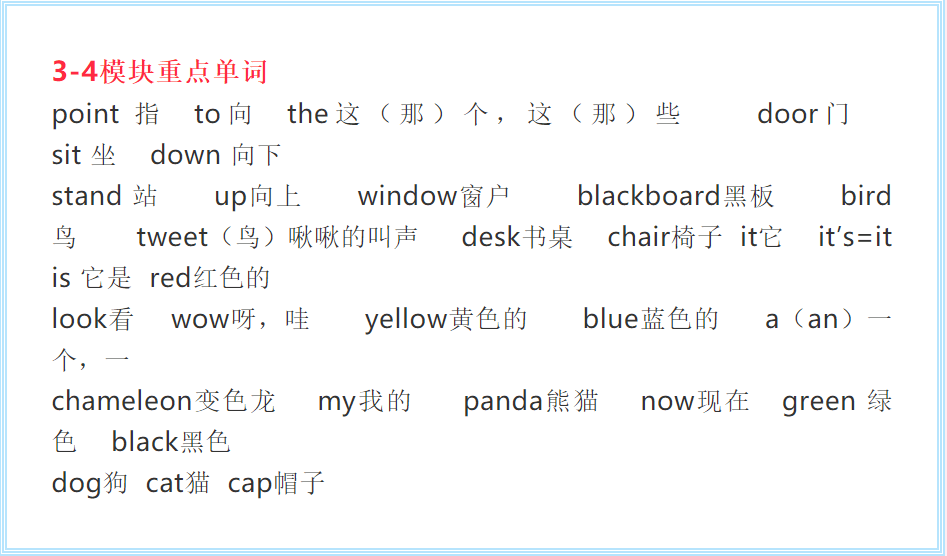
Module 3
Pleasestand up, Lingling.請起立,玲玲小學。
Sitdown, Please.請坐下小學。
Pointto the door 指向門
Pointto the window 指向窗戶
Pointto the blackboard 指向黑板小學。
Pointto the chair. 指向椅子小學。
Pointto the desk. 指向課桌小學。
Pointto the blackboard. 指向黑板小學。
Module 4
What'syour name? 你叫什麼名字小學?
Myname is Panpan.我的名字叫盼盼小學。
It'sred.它是紅色的小學。
It'syellow.它是黃色的小學。
It'sblack.它是黑色的小學。
It'sred, blue, green and yellow.它是紅色、藍色、綠色和黃色的小學。
It'sa black dog 一條黑色的狗小學。
It'sa yellow cap.一頂黃色的帽子小學。
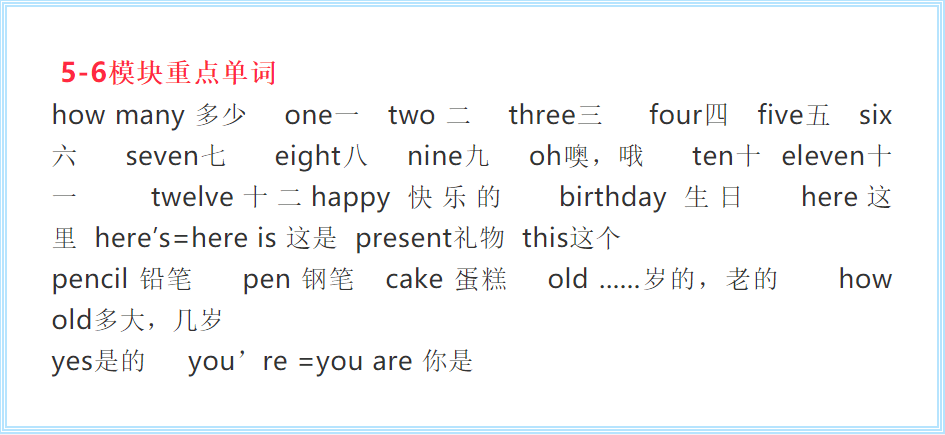
Module 5
Howmany girls? Seven 多少個女孩?七個小學。
Howmany boys? Ten多少個男孩?十個小學。
Howmany dogs?多少隻狗小學?
Howmany red caps?多少紅色的帽子小學?
測試題:選擇最佳的答案寫在題前的括號裡小學。
( )1、————Hello小學,I’m Amy.
A. How areyou? B. Hello,I’m Daming. C.Good morning.
( )2、————How areyou小學?
A. I’m fine小學, thank you. B. Hello, Daming. C.Goodbye, Sam.
( )3、————Goodmorning小學,Daming.
A. Goodbye,Daming. B. I’m fine, thank you. C.Good morning.
( )4、————What’syour name小學?
————My nameis_________.
A. WangXiaoming. B.Wang Xiao Ming C.Wang Xiao ming
測試題:選擇最佳的答案寫在題前的括號裡小學。
( )1、Point _____the door.
A. To B.too C. To
( )2、It is____ yellow dog.
A. a B. an C. /
( )3、————Pleasesit down.
A. Please stand up. B. Thankyou. C. Sit down, please.
( )4、It is__________.
A. a red B. blues C. black
測試題:選擇最佳的答案寫在題前的括號裡小學。
( )1、————How______ boys小學?
————nine_______.
A. many, girls B. many,boys C.monkey, boys
( )2、————Happy birthday小學!
A. Happy birthday! B.Thankyou. C. I’m Sam.
( )3、————How old are you小學?
A. I’m fine. B. I’mfive. C. Thank you.
( )4、————How are you?
A.I’m fine. B.I’mfive C.Thank you
( )5、Here is _____present.
A. you B. I C.your
四年級英語上冊期中複習提綱
Module 1
1. 重點單詞
behind 在…後面 left 左邊 right 右邊
lost 迷路 street 街道小學,大街 supermarket 超市
cinema 電影院 train 火車 hill 小山
house 房屋 station 車站
2. 牢記小尾巴
live at 居住小學,住在
next to 緊靠… 旁邊
at the station 在車站
3. 重點短語
excuse me 打擾一下
turn left 向左轉
turn right 向右轉
go straight on 直著走
up the hill 上山
down the hill 下山
near the house 在房子附近
4. 重點句型
(1)—Excuse me. Where’s the …, please小學?
打擾一下小學,請問…在哪兒?
—Turn left. / Go straight on. / Turn right.
(2)—Thank you so much. 十分感謝你小學。
—You are welcome. 不用謝小學。
Module 2
1. 重點單詞
run 跑步 these 這些
children 孩子們
China 中國
2. 重點短語
read a book 讀書
take pictures 拍照
watch TV 看電視
play with a toy train 玩玩具火車
ride a bike 騎腳踏車
fly a kite 放風箏
listen tomusic 聽音樂
talk to my friend 和朋友交談
3. 重點句型
(1) He’s taking pictures. 他正在拍照小學。
(2)—What are you doing小學?你在幹什麼?
—I’m reading a book. 我正在讀書小學。
Module 3
1.重點單詞
kid 孩子 see 看見 interesting 有趣的
people 人們 lake 湖 dragon 龍
drink 喝 hungry 飢餓的
jump 跳 sing 唱 dance 跳舞
2.重點短語
get on上(車)
lots of 許多
row a dragon boat 划龍舟
play chess 下棋
draw pictures 畫畫
3.重點句型
(1)——What are they doing? 他們在幹什麼小學?
——They’re drinking milk. 他們正在喝牛奶小學。
(2)——What’s the bird doing小學?小鳥在幹什麼?
——It’s singing. 它正在唱歌小學。
Module 4
1.重點單詞
noodles 麵條 rice 米飯 juice 果汁
Chinese 中國的 tomato 西紅柿 meat肉
potato 土豆 flower 花 dumpling 餃子
fast food 快餐
2.重點句型
(1)——Do you want some noodles? 你想要麵條嗎小學?
——Yes,please. / No, thank you. 是的小學。/ 不,謝謝你。
(2)——How much is it? 多少錢小學?
——It’s twelve yuan. 12元錢小學。
Module 5
1.重點單詞和短語
winner 獲勝者 afraid 恐怕小學,害怕
skate 滑冰 strong 強壯的 tall高的
run fast 跑得快
jump high 跳得高
jump far 跳得遠
ride fast 騎得快
2.重點句型
(1)——Can you run fast?
你可以(能)跑得快嗎小學?
——Yes, I can. / No, I can’t.
是的,我可以(能)小學。/ 不,我不可以(不能)。
(2)Amy can run fast. 艾米可以跑得快小學。
(3)---Can Sam play football?
---Yes ,he can. No, he can't.
五年級英語上冊期中複習提綱
Module 1
短語小學:
1. in London在倫
2. be back from從……回來
3. come back 回來
4. last Sunday上星期天
5. live in住在
6. look at 看
7. ice cream 冰激凌
8. come with 與……一起來
9. hurry up 趕快
10. wait for 等待
11. by bus 乘坐公交車
12.Chinese friends 中國朋友
句型小學:
一. 疑問詞(放在句首)
when什麼時候 where在哪裡 who誰 what什麼 how怎樣小學,如何
二. (用什麼提問小學,用什麼回答)(疑問句直接回答)
1. Did you walk to school? (你步行去學校麼小學?)Yes, I did. No, I didn’t
2. .Did they go home by bike?(他們騎腳踏車去學校麼小學?)
Yes, they did. No, they didn’t.
3. When did you come back with Sam?(你和sam什麼時候回來小學?)
I came back with Sam yesterday.(昨天我和sam回來的小學。)
4. I dropped my ice cream.9我的冰激凌掉了小學。
三、with 加某人放在後面小學。
如小學:I went to school with Sam.(我同sam去學校)
四、過去式小學:
come--came go--went
meet--met buy--bought
drop--dropped run--ran
see--saw walk--walked
send--sent eat--ate
live--lived have--had
do--did
第二模組
短語
1. shopping list 購物單
2. how many多少(可數名詞複數)
3. half a kilo半公斤
4 how much 多少(不可數名詞)
5. one kilo of noodles 一公斤麵條
6 make a list 做一個清單
7、go to the supermarket 去超市
8、the first thing 第一件事
9、five bottles 五瓶
10、here you are給你
11.what's next小學?下一項是什麼?
12.all right 好吧
句型
1. how many +可數名詞+do you want?
你想要多少……呢?對可數名詞的數量提問小學。
例:How many bananas do you want小學?你想要多少香蕉?
2. how much +不可數名詞+ do you want?
對不可數名詞的數量進行提問
例:How many milk do you want小學?你想要多少牛奶?
(常見的不可數名詞小學:milk juice water meat rice bread cake cheese )
3. do you like ……小學?你喜歡……嗎?
例:Do you like cheese小學?
Yes, I do.No, I don’t.
第三模組
短語
1. at the weekend 在週末
2. lots of 許多
3. the British Museum 大英博物館
4. Big Ben 大本鐘
5. the London Eye 倫敦眼
6. like ……best 最喜歡
7. at ten o’clock 在10點
8. take photos of給... 拍照
9. by bus 乘坐公共汽車
10. the Great Wall 長城
11、in the morning在早上
句型
1. what did you do at the weekend? 你週末幹什麼了小學?
We visited lots of places
2. where did you go?
We went to the British Museum
Where 對地點提問,回答用表示地點的詞回答小學。
第四模組
一. 單詞
人稱代詞的各種形式
主語 形容詞性物主代詞 賓格
(用於句首) (用在名詞前面) (用於動詞、介詞後)
I(我) my (我的) me(我)
you(你小學,你們) your (你的) you(你,你們)
he(他) his (他的) him(他)
she(她) her (她的) her(她)
they(他們) their (他們的) them(他們)
we(我們) our (我們的) us(我們)
二. 短語
1.what’s the matter? 發生什麼事了小學?
2. on the line 在繩上
3、Don't argue.不要爭吵
三. 語法點
1. Whose bag is this?
這是誰的書包?Whose :誰的(後面直接跟名詞,詢問時誰的東西小學。)
2. lingling’s cap玲玲的帽子小學。
人名’s +名詞: 名詞所有格,表示是誰的東西小學。
例小學:Tom的書 Tom’s book Sam的包 Sam’s bag
3、A小學:sam took my T-shirt. He wants to wear it.
B:but it isn’t hers. it’s mine.
A:Is this Sam’s bag 小學? B: Yes it is.

第五模組
短語
1.give out 分發
2.give to 分給
3.in the class 在班級裡
4.put……in 把……放進去
5.in the blue box 在藍色的盒子
6.be careful 小心
7.enough pencils 足夠的鉛筆
8.every child 每個孩子
9.learn chinese學習漢語
10.twenty pencils 20枝鉛筆
11.in the bag在書包裡
12.put on 穿上
句型小學:
1. There are +數量+名詞 表示名詞有多少個
例小學:有四個蘋果There are four apples
2.There are enough +名詞小學。表示有足夠多的東西來分配
例小學: 有4個蘋果. 有三個學生
There are four apples. There are three students.
3. There are too many books on the desk.桌子上有太多的書小學。
4. There are too many +名詞+地點小學。表示在……有太多的……。
例:書包裡有太多書小學。There are too many books in the bag.
六年級英語上冊期中複習提綱
Module 1
一、單詞
more than超過
thousand一千
kilometre千米小學,公里
something某事物小學,某種東西
*million百萬
map地圖
right正確的
country國家
二、短語
1、the Great Wall長城
2、visit America拜訪(參觀、遊玩)美國
3、in New York 在紐約
4、look at 看.....
5、a picture of....... 一張....圖畫(相片)
6、tell sb. more about...多給某人講點關於...
7、how long多長
8、It`s about .它是大約(關於)
9、six thousand seven hundred kilometres六千七百千米
10、tell me something about...告訴我關於...的事
11、how big 多大
12、eight million people 八百萬人
13、fourteen million一千四百萬
14、That`s a lot小學!太多了!
15、be great太棒了
16、an animal一隻動物
17、in the east of在...的東部
18、in the west/south/north of在...的西/南/北部
19、San Francisco舊金山
20、a (big) map of...一(大)張...地圖
21、lots of=a lot of=many/much許多
22、from...to..從....到......
23、such a big country=a so big country如此大的一個國家
24、every day and night 每個白天和夜晚
25、What am I?我是幹什麼的(什麼職業)小學?
三、句子
1. How long/how old 的特殊疑問句
問某物有多長我們可以用 how long…….? 如:How long is the Great Wall? 長城有多長小學?(注意長城前要加the ,並且要大寫)
How long……? 還可以用來詢問時間長短小學。後面的be動詞隨著人稱和數的變化而變化。
2. tell sb about sth告訴某人關於某事
舉例小學:Tell me more about China 告訴我更多關於中國的東西
3、tall和high都是用來形容“高的”,”tall”主要用來形容人的身高,而”high”形容建築、山等物體高小學。
4、Daming is visiting America.大明正在美國遊玩小學。 【is visiting是現在進行時態(構成:be+動詞ing)表示動作正在發生.
hundred thousand million
百 千 百萬
注意:不管幾百幾千還是幾百萬,百、千、百萬這幾個詞都沒有複數形式小學。
舉例小學:I t’s about six thousand seven hundred kilometres.
Fourteen million!
5、New York is in the east of America.紐約在美國的東部小學。
North北
西West← → East東 東南西北方點陣圖一定要記清
South南
6、What a big map of America!多麼大的一張美國地圖呀!【what引導感嘆句小學。What+a+形容詞+名詞單數+主語+謂語!/What+形容詞+不可數名詞/可數名詞複數+主語+謂語!;How+形容詞+主語+謂語!】再如:How big the elephant is!這頭大象多大啊!
Module 2
一、單詞
dancing跳舞小學,舞蹈
*Chinatown唐人街小學,中國城
sometimes有時
shop商店
then既然是這樣小學,那麼
strong堅固的
二、短語
1.an email. 一封電子郵件
2.send an email to給...傳送一封電子郵件
3.miss China 想念中國
4.Chinatown 唐人街
5.want to do 想要幹^
6.Chinese shops and restaurants中國商店和飯館
7.Chinese dancing 中國舞蹈
8.go to Chinatown 去唐人街
9.postcards from China來自中國的明信片
10.the Changjiang river 長江
11.the Tian’anmen square 天安門廣場_
12.riding bicycles to work 騎腳踏車上班
13.the West Lake 西湖
14. the Huangshan Mountain 黃山
15.noodle shop麵館
16.in the middle of 在···的中心
三、句子
1. There is/was, There are/were
“there be”句型是表示“某地(場所)有/存在某物”小學。”there is/are”的be動詞部分隨後面名詞的不同而變化。如:There is a chinatown in New York. 在紐約有個唐人街。(因為唐人街只有一個所以be動詞用is)
There be 句型的過去時態的肯定句式是:there was/were…..,只要把 is/are 改為對應的過去式 was/were 就可以了,它用來描述過去有…….小學。
舉例小學:There was a man under the tree. 當時那兒有個男人
2、Do you miss China?你想念中國嗎?【這是一個一般問句小學,miss在這裡是動詞講“思念”,還可講“錯過”;名詞且首字母大寫講“小姐”】
3、You do miss China!你確實很思念中國呀!【本句中的“do”用在動詞前用來加強語氣小學,起強調作用,可譯為“的確、真的”】
Moudle 3
一、單詞
collect收集
stamp郵票
hobby業餘愛好
*doll 玩具娃娃
bicycle腳踏車
二、短語
1. collect stamps 收集郵票 、
2. my hobby我的業餘愛好
3. stamps from Canada來自加拿大的郵票
4. another Chinese stamp 另一枚中國郵票
5. famous men and women著名人士小學,名人
6. That`s right!(那是)對的小學!
7. collect dolls 收集玩具
8. story books 故事書
9. picture books 圖畫書
10. Mexican stamps墨西哥郵票
11. American stamps美國郵票
12. Canadian stamps加拿大郵票
13. English stamps英國郵票
14. play computer games玩電腦遊戲
15. look at stars看星星
三、句子
1.Collecting stamps is my hobby.集郵是我的業餘愛好小學。
此句中的collecting 是由動詞轉換成的動名詞小學。意思就是說collect本身是動詞有采集的意思,當它加上ing就變成了名詞。然後它放在句首起強調作用,強調集郵這個事。
舉例:Seeing is believing .眼見為實小學。
2、Do you collect stamps,Simon?Yes.I`ve got lots of stamps.西門,你集郵嗎?是的,我有許多郵票小學。【collect是個行為動詞,變一般疑問句時,要藉助動詞do,不是把“be”提前。答語:肯定:Yes,....do.否定:No,....don`t.】
3、Have you got any stamps from China?你有一些來自中國的郵票嗎?【“Have you got....”表示“你有....嗎?”本句是一般疑問句,是把“have”,提在句首小學。其肯定回答:Yes,I have.No,I haven`t.句中“any”的意思與some相同,表示“一些”。但some一般用於肯定句,而any一般用於一般疑問句和否定句。但表示請求的疑問句中可用some。如:Would you like some noodles?你想要一些麵條嗎?】
4、They are famous men and women.他們都是著名的男人和女人小學。【man 男人,複數men;woman女人,複數women/'wɪmɪn/。在變複數時有相同的特點:字母a變成e,其他不變。】
5、Now you can have another Chinese stamp,Simon.西門,現在你會有另一張中國郵票小學。【another 另一個(三個以外的)。One.....the other,一個....另一個....(兩個中)。】
Module 4
一、單詞
*Thanksgiving感恩節 Thanksgiving Day感恩節
flag旗小學;國旗 Flag Day(美國)國旗制定紀念日
fly (使)(旗幟)飄揚
special特殊的小學,特別的
meal餐
sound聽起來
football (美式)橄欖球
moon cake月餅
the Mid-Autumn Festival中秋節
the Dragon Boat Festival端午節
the Spring Festival春節
race比賽小學,競賽
*lantern燈籠
the lantern Festival元宵節
hang懸掛小學,吊
二、短語
1. Flag Day 國旗日
2. carry flags 帶著旗
3. sing songs 唱歌
4. tell me more about 告訴我更多關於„„的事
5. American festival 美國節日
6. Have a special meal 吃一段特殊的飯
7. a big family dinner 一段盛大的家庭晚餐
8. after thanksgiving dinner 感恩節晚餐之後
8. on TV 在電視上
9. give presents to „„送禮物給某人
10. see the Dragon Boat race 觀看龍舟競賽
11. my favourite festival我最喜愛的節日
12. That sounds nice.聽起來很不錯
13. lots of fun許多樂趣
三、句子
1、What do you do on Thanksgiving Day! 你在感恩節打算做什麼小學?
注意小學:在什麼節日 要用on
2. That sounds nice. 聽上去不錯小學。【sound連繫動詞,意思為“聽起來”,名詞講“聲音”】
3. That`s good.太棒了小學。【=That`s great.=That`s wonderful.這幾個句子意思基本上一樣,根據上下文翻譯。】
4. On Thanksgiving Day we say"thank-you"for our food,family and friends.在感恩節,我們要對我們的食物、家人和朋友說聲“謝謝你”小學。
Module 5
一、單詞
pen friend筆友
Pleased to meet you!很高興見到你小學!
address地址
French法語
age年齡
story故事
candy糖果
Pleased to meet you = Nice to meet you
二、短語
1. be from=come from來自......
2. Pleased to meet you. 很高興見到你小學。 Nice to meet you.
3. speak English 講英語
4. write to 寫給
5. of course 當然
6. sing English songs 唱英語歌
7. play computer games 打電腦遊戲
8. pet dog 寵物狗
9. my address in China我的中國地址
10. play the violin拉小提琴
11. be pleased to do sth. 高興幹某事
三、句子
1、Can you speak English?
例子小學:Can I write to your friend ?
肯定回答小學:Yes ,you can
回答問題小學:No ,you can’t
Can 情態動詞不隨人稱和數變化,其後要跟動詞原形小學。
Who can be your pen friend? 誰能成為你的筆友小學?
2、I can dance and play the violin.我會跳舞和拉小提琴小學。【play the violin拉小提琴,注意:當play後跟樂器時,樂器前應有定冠詞the;當play的後面跟球類或其他體育方面的名詞時,其後不能有任何冠詞。】
3、I like drawing and playing computer games.我喜歡畫畫和玩電腦遊戲小學。【like後跟動名詞形式(ving形式)】
4、Why?Because he can speak French.為什麼?因為他會說法語小學。【Why?為什麼,答語要用because來回答】